

My beloved Stackers,
The initial intent here was six editions. Two and a half years later?
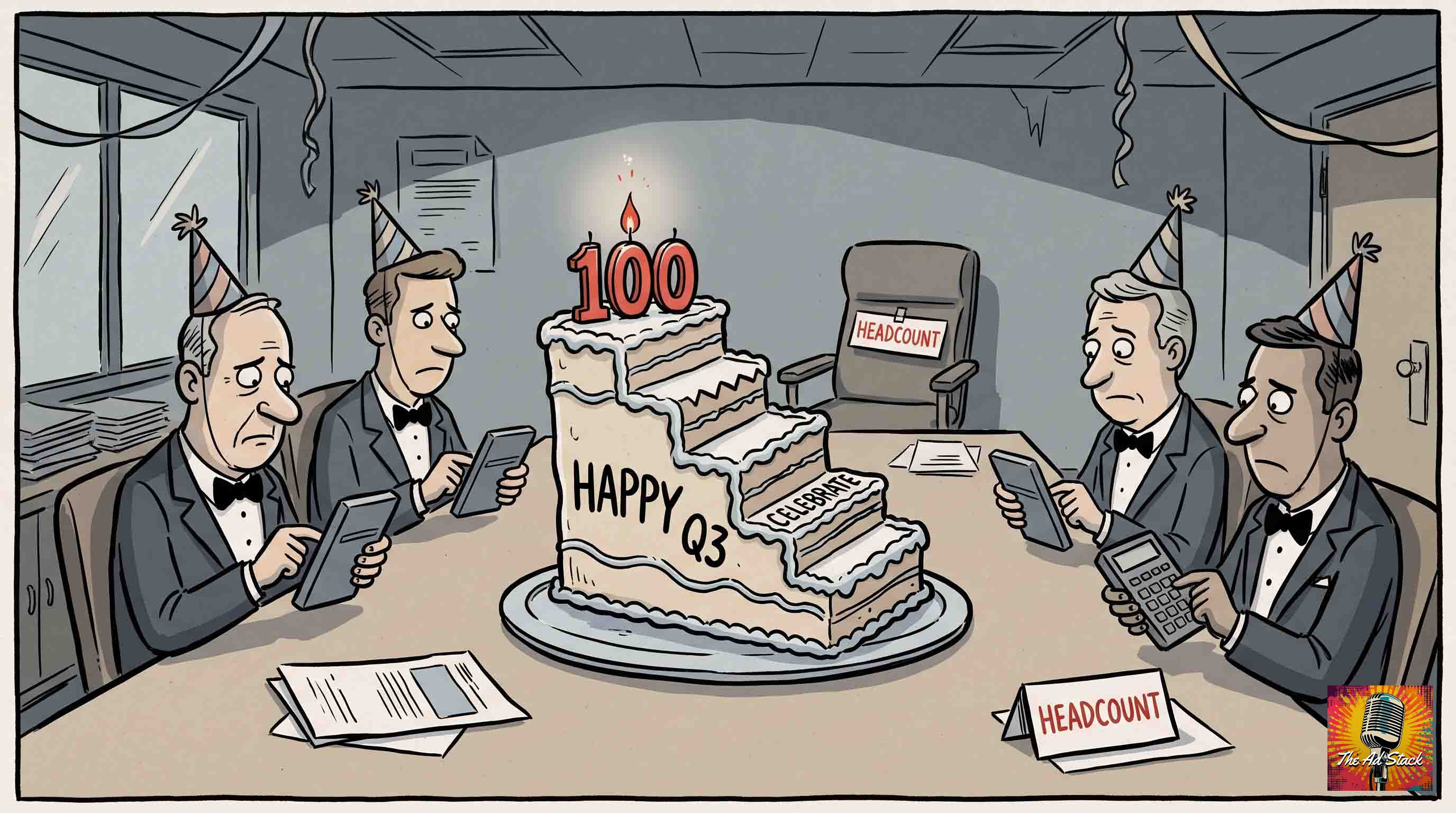
Presenting Edition 100. One hundred editions of standing in the audience while the industry does it to itself.
We asked for a cake. The industry sent quarterly earnings, a bankruptcy filing and a chatbot that rewrites your headlines without asking. Close enough.
Pull up a chair.
1. The Q3 Holding Company Spectacular
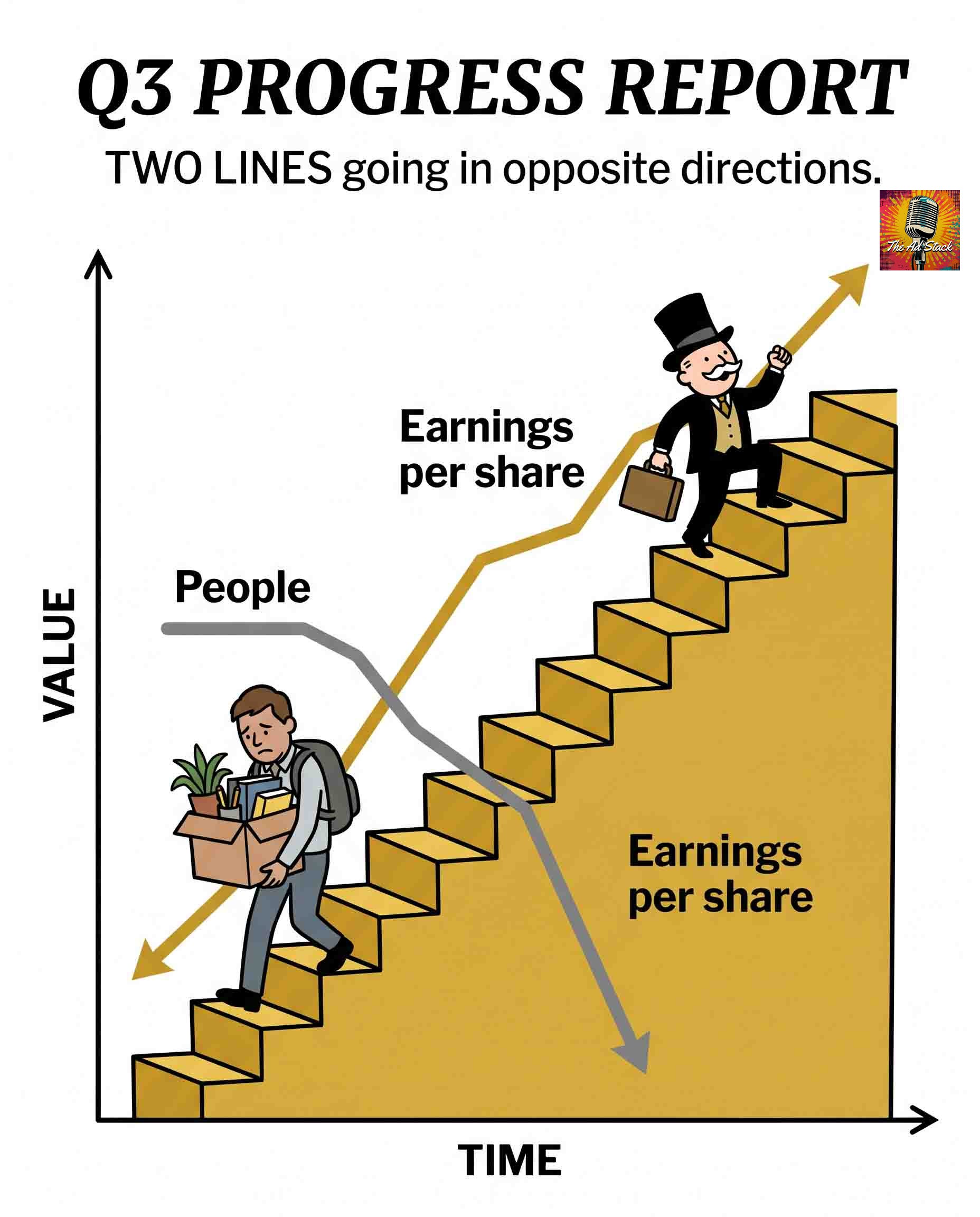
Five acts, one plot twist: the revenue showed up and the people didn’t.
Every October the holding companies take the stage, one by one, to perform their quarter for an audience of analysts who have seen the show before. This year’s production had a surprise. Most of the acts were good.
That is the problem. Here is the program.
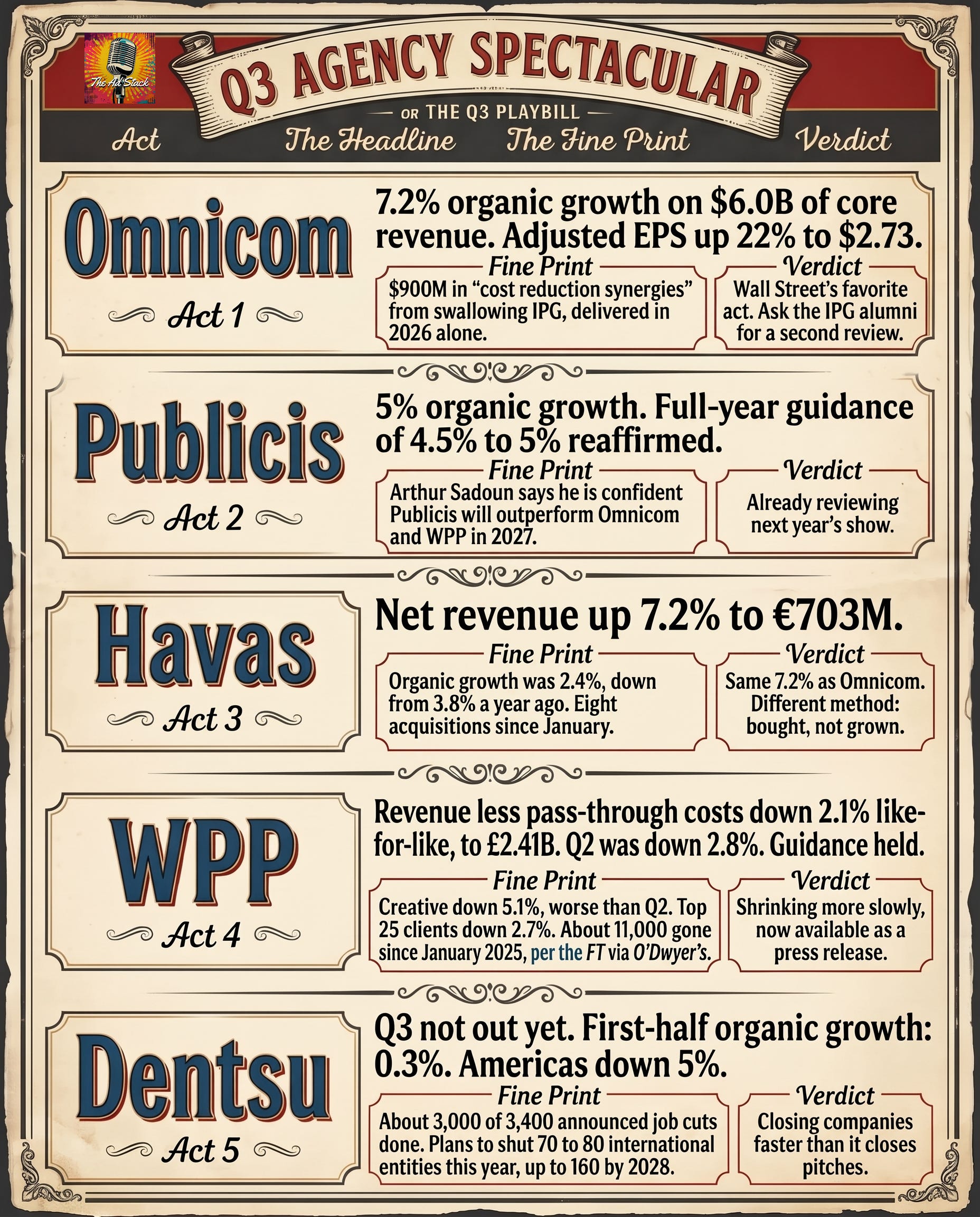
The pattern is the whole article.
Three of five grew. One flatlined (Dentsu). One shrank (WPP). Havas squeaked into the growth column at 2.4%. Margins went up. Earnings per share went up. The number that is going down (everywhere anyone bothers to publish it) is people.
The quote of the quarter!
WPP’s CFO Joanne Wilson, explaining the Elevate28 plan and its £500M in savings, told investors: “In a business where most of our cost savings are people, that will mean a reduction of certain heads.”
Certain heads.
Not all heads. The ones at the top of the org chart appear to be load-bearing.
Over at Omnicom, John Wren says the company will keep “investing in our people and agentic technology.” The $900M synergy number from swallowing IPG tells you which of those two investments is getting the bigger check.
In holding company English, “synergy” has never once meant cheaper paper clips.
The contrarian bit: The Great Holding Company Collapse?
It would be easy to call this The Great Holding Company Collapse. It isn’t. Omnicom (7.2% organic) and Publicis (5%) are healthy businesses, growing faster than most of their clients. The doom narrative that the holding companies are dying is wrong.
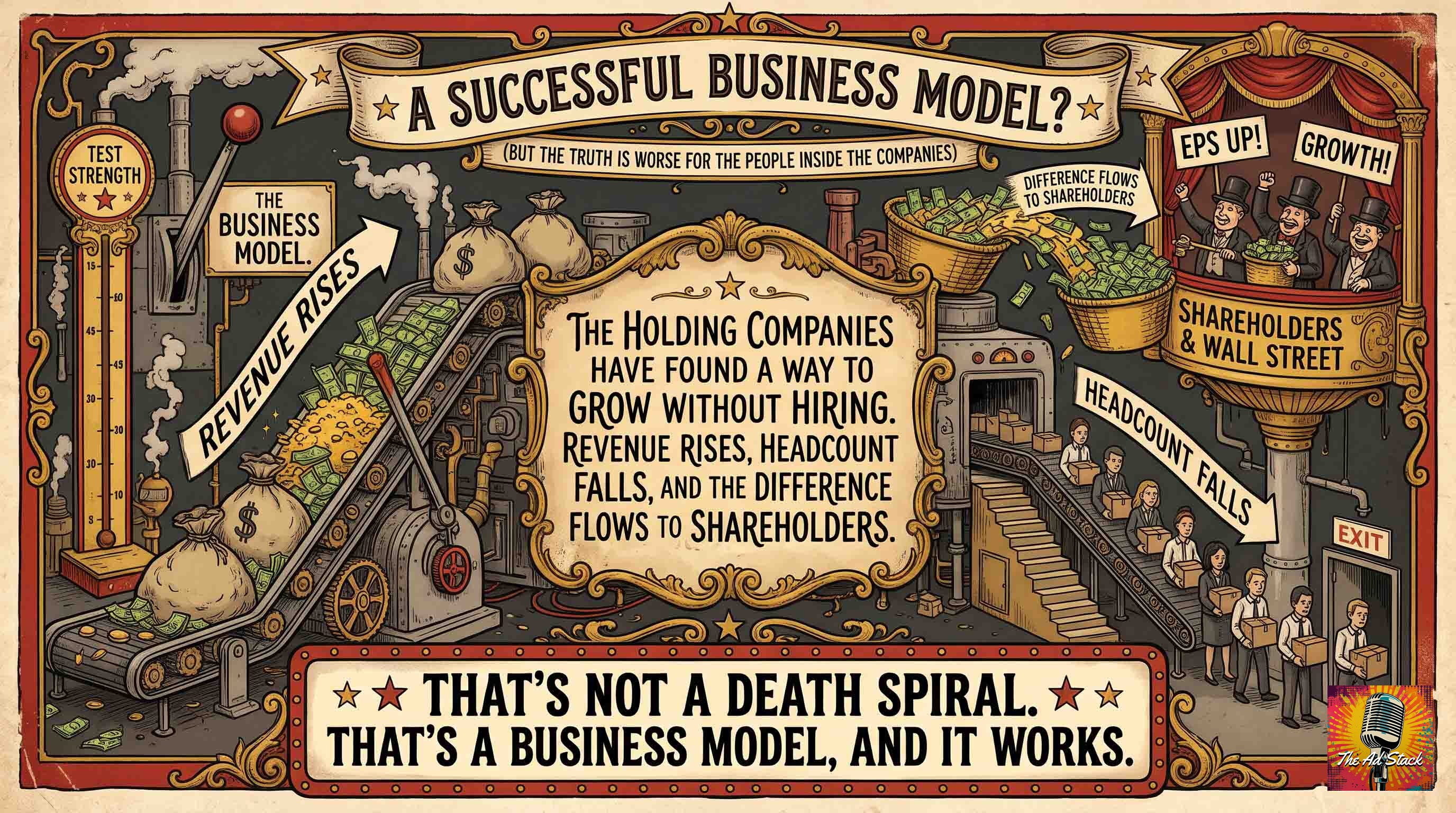
The truth is worse for the people inside them. The holding companies have found a way to grow without hiring. Revenue rises, headcount falls, and the difference flows to shareholders. That’s not a death spiral. That’s a business model, and it works.
WPP Shrinks Slower, Calls It Momentum.
WPP reported last week. Revenue less pass-through costs fell 2.1% like-for-like in Q3, to £2.41 billion, per Reuters. (Top-line revenue ticked up 0.5%. That’s not the number that pays salaries.) Q2 was down 2.8%. The first half was down 4.7%. A year ago Cindy Rose called WPP’s performance “unacceptable.”
This year she says WPP is “stabilising.” Progress, measured in adjectives.
Guidance held: the second half still declines low to mid single digits, and the margin still lands at 12% to 13%. WPP Media grew 0.3%. Creative fell 5.1%, worse than Q2’s 3.5% drop. The top 25 clients spent 2.7% less, per Medianews4u. The world’s most famous creative company is now mostly a media buyer with a creative hobby.
CFO Joanne Wilson will step down in 2027, Rose told the call. Wilson’s pitch to her successor: “It’s a fantastic time to join the business.” No Burson sale. Wilson says Burson grew in Q3, and WPP still promises at least £200 million from disposals this year. The trading update gave no headcount.
Rose closed with: “no one is more impatient than I am to see that happen.” The almost 11,000 people cut since January 2025 might dispute the ranking.
The holding companies aren’t dying. They’ve just learned to grow without anyone in the building.
2. Nobody Approved This Headline
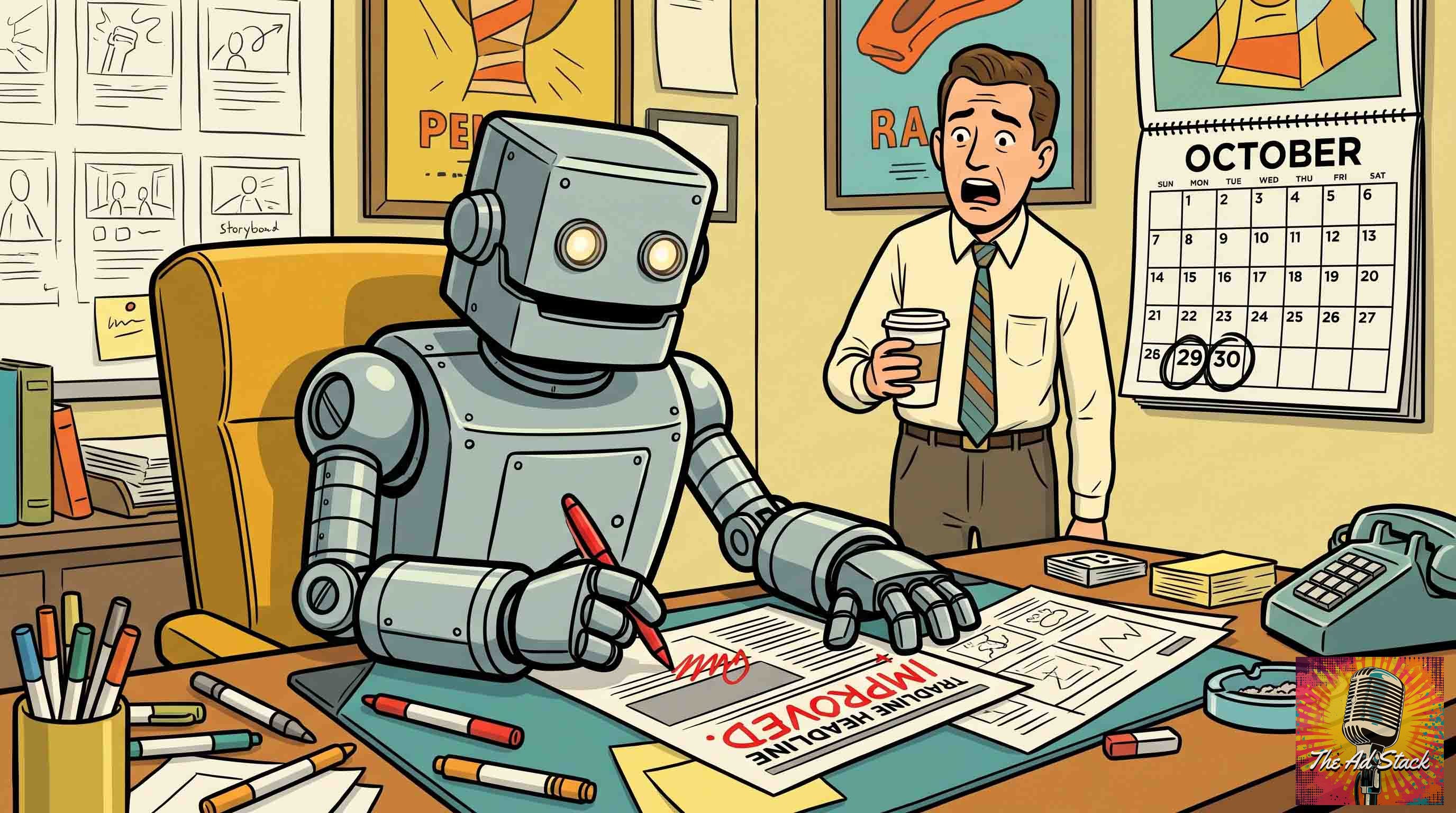
OpenAI will now rewrite your ads. And your landing page. By default.
While WPP explains on Thursday how it will cut people to fund AI, OpenAI flips a switch that does the copywriter’s job for free, without asking.
Starting this week, ChatGPT’s self-serve ads get “creative enhancements” turned on by default. The system can change four things: your headlines and descriptions, the language your ad runs in, your image sizes, and your destination URL.
OpenAI’s own email to advertisers: “When enabled, these ads can run automatically without requiring you to review or approve each version.”
One toggle covers all four. You can’t keep the translation and refuse the rewrite. The email arrived October 20. The email says the switch flips October 30. OpenAI’s help page says October 29. Even the launch date didn’t go through approvals.
The revised creative brief
(A found document. We wrote it. Nobody approved it, which is the point.)
CREATIVE BRIEF, v.FINAL_FINAL_ChatGPT
Client: You
Headline: Improved
Language: Several
Landing page: A relevant page on your site, chosen for you
Approvals: Not required
Agency of record: Was consulted. Retroactively. In this brief.
Meanwhile, in measurement
One agency saw ChatGPT report about 100 clicks where its own tracking found 20. Conversions arrived 24 to 36 hours late. UTM tags no longer pass through, so Adobe now counts that traffic as direct, with “no tag and no referrer.”
So the platform writes the ad, picks the page, and grades the results. The advertiser supplies the money and the trust.
The contrarian bit: None of this is new.
Google and Meta have pushed auto-generated creative for years through Performance Max and Advantage+. The industry swallowed it from the two companies that hold most of the budget.
OpenAI is just copying their terms with a fraction of the leverage. One executive whose clients spend $10M a month on Google puts under $100K a month into ChatGPT. The scandal isn’t that OpenAI asked for control. It’s that the industry already gave it away, and the newcomer noticed.
The platform writes the ad, picks the landing page and grades the results. You supply the money and the trust.
3. Other Almost Newsworthy News
Stories that would have led any other week. This week they get a paragraph and a verdict.
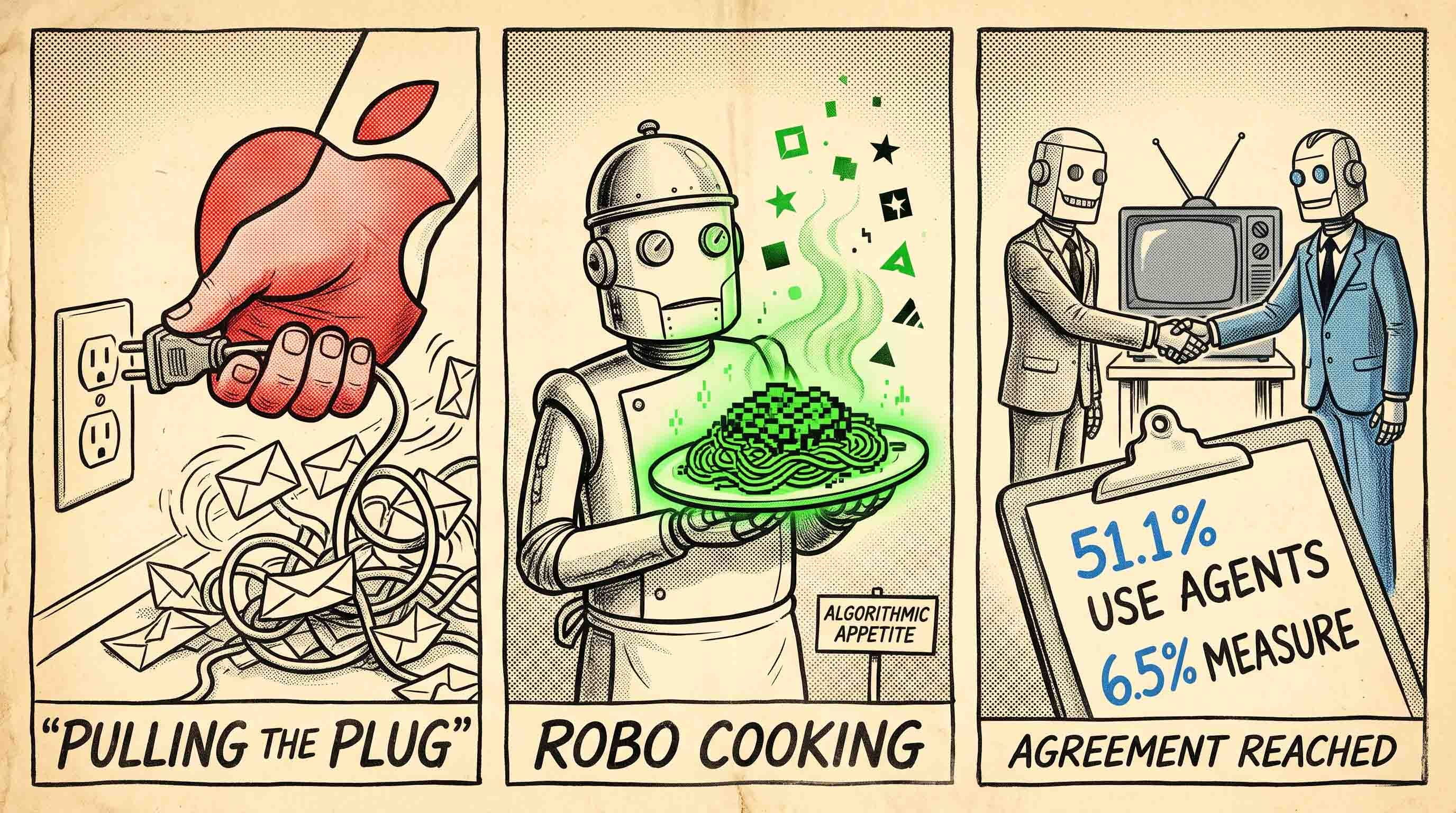
Apple quietly unplugs the identity graph.
In iOS 27, Safari blocks email-based identity vendors. The Trade Desk, LiveRamp, ID5, Permutive and Audigent were on the first list. That list has since grown into a dynamic library of hundreds of vendors, on iPhones, iPads, Macs and Vision Pro. Apple hasn’t said who’s on it or how to get off. AdExchanger says identity resolution is going “the way of the cookie.”
Verdict: An entire product category, retired by a browser update.
AI slop is the new made-for-advertising inventory.
A DecryptAds study found 2,116 AI-generated recipe sites with fabricated authors, overlapping ad slots and ads from major brands. Meanwhile, 84% of requests claiming to be OpenAI’s GPTBot crawler turned out to be fake, per Centinel.
Verdict: Brands are paying to appear beside recipes no human has cooked, written by chefs who don’t exist.
Your media buyer is now an API call.
Fox extended agent-to-agent deal-making to linear TV, with WPP, Omnicom and Horizon Media as partners. Simulmedia reports more than 300 spot-level orders executed agent to agent across five Fox properties. A Basis survey of 184 marketers found 51.1% of organizations use AI agents. Only 6.5% measure those investments against defined benchmarks.
Verdict: Half the industry has hired robots. One in fifteen checks whether they’re any good.
4. Getty Didn’t Lose to AI. It Lost to Your Agency’s Midjourney Login.
A eulogy for the stock house that never missed a deadline, and a word with the people who stopped calling.
Getty was worth $4.8 billion four years ago. Its shareholders now get zero. On October 21, Getty Images filed for Chapter 11 in Delaware. The Getty family and Koch Equity Development will put in up to $533M of new equity and take full ownership. Koch is providing up to $143M of financing to get through the process, and Getty had drawn $85M of it by October 23. The company expects to emerge by year end and says photographers, contributors and customers won’t see disruption.
Public shareholders get nothing. The stock debuted around $26 in its 2022 SPAC deal, back when Getty was worth $4.8 billion. It ended at about eight cents.
First, the kind part
If you ever ran a production department, you know who Getty is. It was the call you made at 11pm when the shoot fell through, the legal team wanted a cleared image and the client wanted it by morning. They always picked up.
And the business still works. First-half revenue was $455.7M, a run rate of about $910M. Adjusted EBITDA margin was 27.2%. Editorial revenue grew 9.2%. Plenty of agencies would kill for those margins, and some of them have.
What broke Getty was mostly the balance sheet. It carried $2.1B of debt against $51.6M of cash, roughly 8x leverage. The merger with Shutterstock that might have fixed it died after UK regulators demanded Shutterstock sell its editorial business. Getty spent more than $100M on that merger and got nothing.
Now, the rest of it
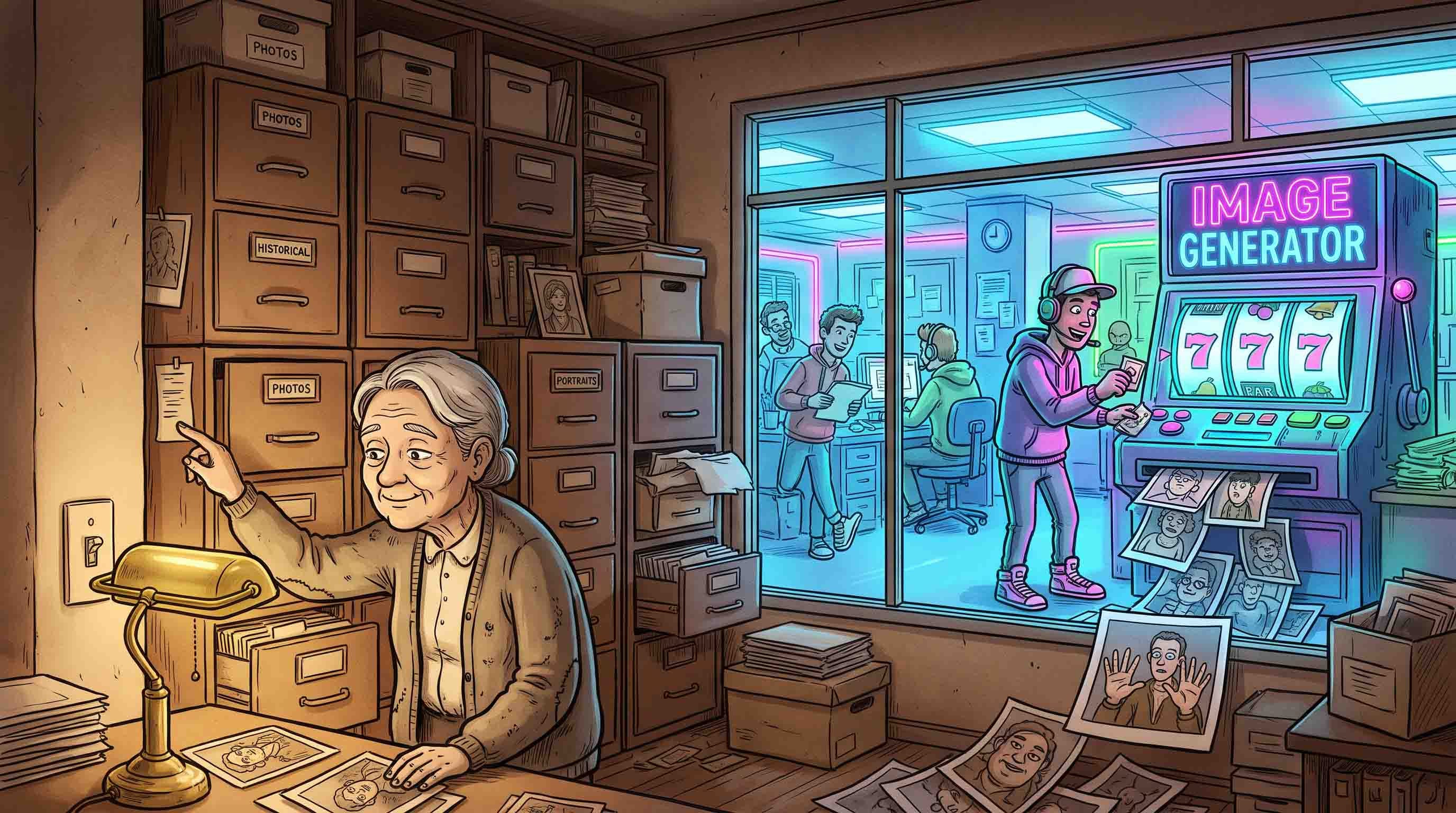
Here is the push. Annual subscribers fell 25% in a year, from 321,000 to 240,000. Agency revenue fell 13% in a single quarter. Getty’s CEO said the agency business model now pushes agencies to make content in-house, “including with AI.”
So the stock house got cut so agencies could feed an image generator, then bill clients for the output as “original creative.” The same agencies that spent 20 years asking Getty for model releases, location releases and indemnification now ship pictures nobody can trace, from tools whose training data nobody on the account can explain.
The agency saves on licensing. The client is still paying the agency’s rate card.
To every holding company “AI content studio” now making six-fingered lifestyle shots for brands that used to buy cleared photography: you didn’t disrupt Getty. You stopped paying for the thing you’re still charging for.
Who’s next? (Speculation, clearly labeled)
This is our guess, not reporting. These are the businesses that sell what an image or text generator now fakes for free, ranked by how loudly the clock is ticking.
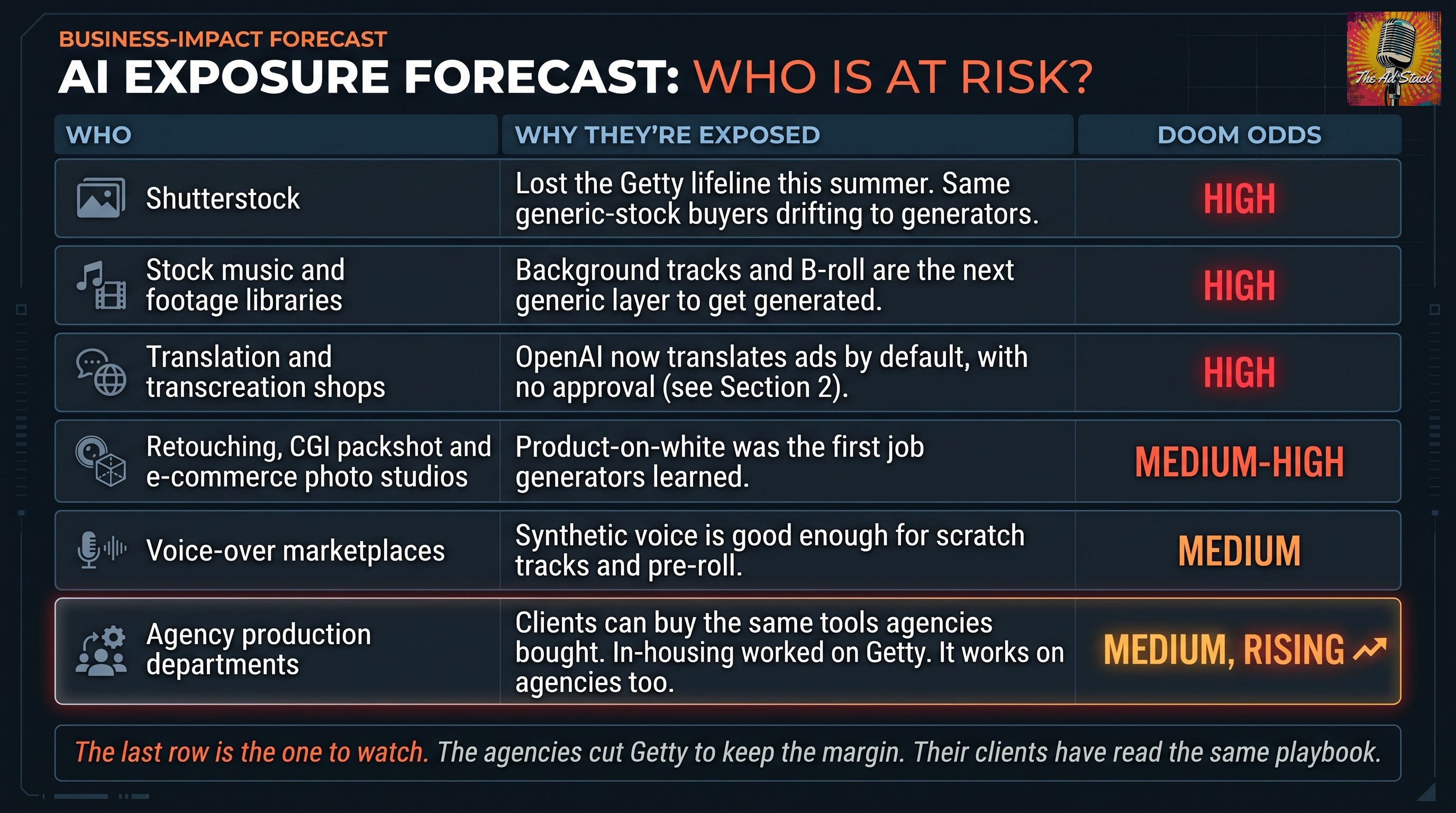
You didn’t disrupt Getty. You stopped paying for the thing you’re still charging clients for.
Thanks for Stacking
One hundred editions in, the story hasn’t changed much. It just got better margins.
If this one made you laugh, wince or forward it to someone in a holding company finance department, that’s the job. Whack the bejabbers out of the share button.
Sourcing note: The creative brief in Section 2 and the “Who’s next” table in Section 4 are our own inventions and opinions, labeled as such. Every number elsewhere comes from the sources below.
Sources
Adweek: Havas Grows in North America as It Lags in Other Regions
Campaign: Dentsu weighs cutting up to 160 overseas entities by 2028
Editor & Publisher: Getty draws $85M in bankruptcy financing
Fast Company: Getty Images was worth $4.8 billion 4 years ago
Reuters via Euronext: WPP says turnaround on track as third-quarter revenue decline narrows