

Morning, all. Been a while. This one has been kicking around the office for about a month.

Every few years …
… this business gets bored of its units of account and mints a fresh one, roughly the way a man in the back half of a midlife crisis buys a boat. CPM, CPC, CPA, ROAS. Each arrived on a white horse trailing decks and webinars and a Cannes panel, promising to finally measure the thing that actually mattered. Each got quietly reclassified as “directional” the moment somebody checked the math in daylight. We buried them all in the same field and we did not put up markers.
The newest arrival is The Token, the atomic unit of an AI model’s labor, and I will grant that the pitch is the best one we have ever been handed. For the first time in the entire history of advertising, thinking has a price per unit. Feed in a word, get billed a fraction of a cent. Multiply that by the millions of tokens a single campaign now sets on fire and you have, in theory, a perfectly transparent, fully auditable, almost embarrassingly grown-up cost basis for AI-assisted work.
In practice nobody agreed on what a token is worth, who pays for it, or whether the client is permitted to look at the meter at all. The industry built the most precise clock it has ever owned, put it in a drawer, in an office, on a floor you do not have a badge for, and then billed you for the drawer.
1. A Currency With No Exchange Rate
A recent Coca-Cola campaign reportedly required 70,000 prompts and millions of tokens. What that cost, and who ate it, has never been disclosed by anyone, to anybody, at any point. That is not an oversight. That is the house style, and the house is quite pleased with it.
Merge and Big Spaceship bill tokens as metered pass-through line items, like a business selling a thing to a customer who is allowed to know the price of the thing. Revolutionary.
RPA does the precise opposite and swallows the cost whole, on the reasoning that the payoff is “too uncertain” to put in front of a paying client, a sentence that in any other category on earth would trigger an immediate and slightly panicked phone call.
Anomaly’s chief AI officer declines the euphemism entirely and calls token markups “a money grab,” which is either refreshing candor or the loudest quiet part spoken in the trade press this year.
Pencil is out negotiating bulk-rate contracts directly with Anthropic and OpenAI like a trading desk hedging pork bellies, which would be genuinely impressive if a single person could tell you what the underlying commodity is going to do.
Horizon Media shipped a platform called Blu in December 2025 and had 40 clients on it inside a few months, which tells you the appetite is real even where the pricing is imaginary. And Silverside has looked at this entire situation, sighed audibly, and priced it like Salesforce. Flat per-seat subscription. Use it or don’t. The compute meter is now somebody else’s anxiety disorder.
Five shops. Five incompatible pricing philosophies. Same market, same Tuesday, same client base, every one of them nodding warmly and explaining that this is completely normal.
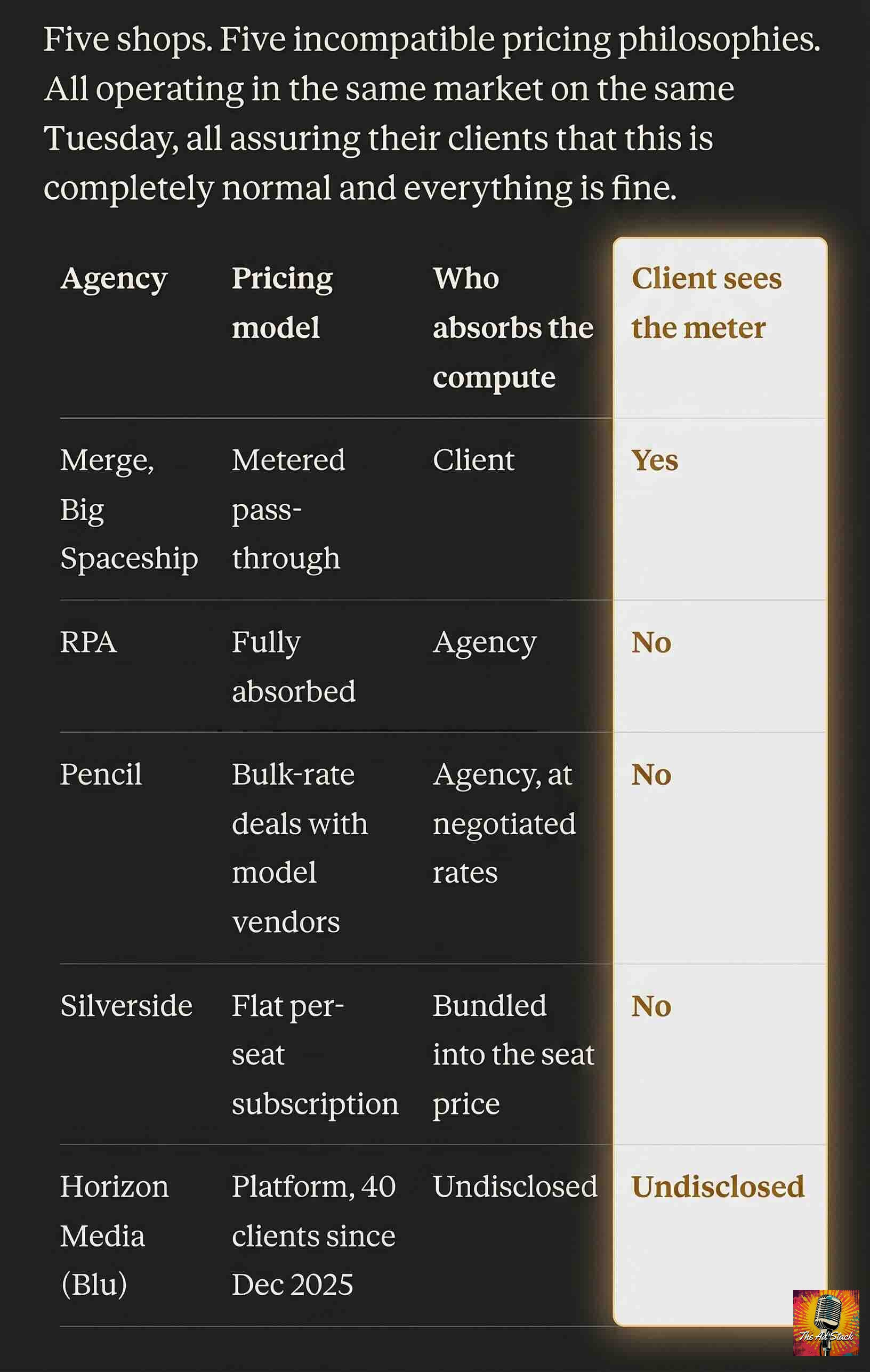
Read the last column. One yes. That is the whole article. Everything below is elaboration.
IAB Europe’s chief economist, Daniel Knapp, said the quiet part directly into a live microphone, on the record, with his name attached to it: “No one knows how to price that in yet.”
Credit to the man for saying it out loud. Now sit with what he actually said. Not “the pricing is complex.” Not “the models are evolving.” Not “we are working through frameworks with our partners.” No one knows. The industry shipped the product before it built the invoice and is now composing the invoice in front of the customer, freehand, in pen, while maintaining warm and confident eye contact.
2. The Oldest Trick In The Business, Now With A Fresh Line Item
Where the pricing has not been solved, it is being buried, and the burial is the part that stops being funny.
Digiday reported a CMO renewal in late July where a holding company offered to absorb the client’s entire AI infrastructure bill in exchange for routing 70% of the media budget through “principal” inventory. For anyone fortunate enough to have avoided that term:
Principal media is inventory the agency already bought, already owns, and then resells to its own client at a markup it sets by itself. So the offer on the table was, roughly: we will make your frightening new AI cost disappear, and all it will cost you is seventy percent of your media budget, routed through the one place on earth where we set the price and you cannot see it. Free. Like a puppy.
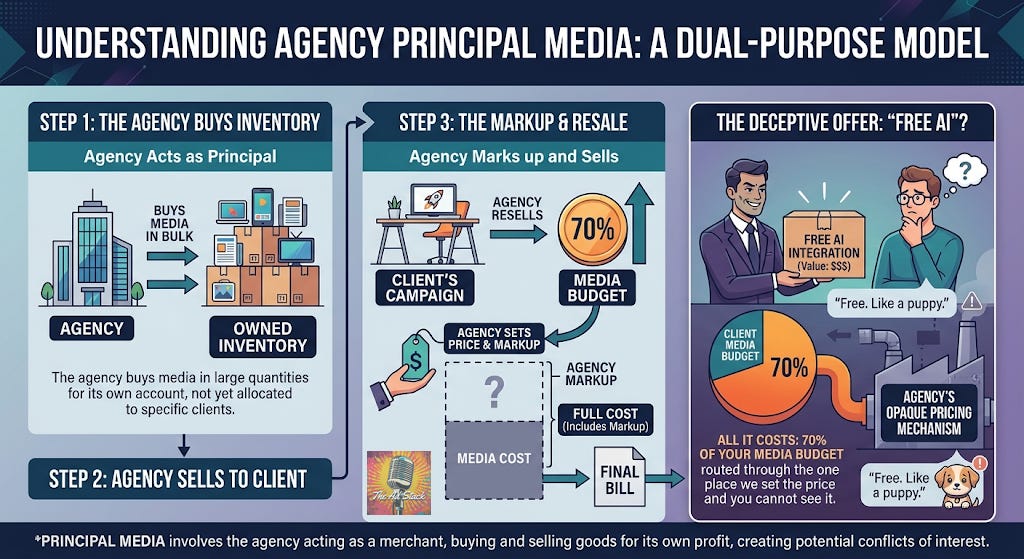
One executive called this “the newest mechanism.” The newest. One executive called this 'the newest mechanism.' The newest. It is the industry's oldest laundry in a better suit."
The people whose entire professional purpose is to be suspicious of this are, mercifully, suspicious of it. Robert Webster of TAU put it in four words that belong printed on the inside cover of every SOW in the country:
“disclosed doesn’t mean aligned.”
An agency can confirm the tokens were spent without handing you a single instrument for deciding whether one of them needed to exist. Total transparency into a number you have no means to evaluate is not transparency. It is a receipt written in a language nobody intends to teach you.
Ruben Schreurs named the sharper problem underneath. If agencies commit to bulk token capacity now and model prices keep falling, which they have done repeatedly and predictably since 2023, agencies end up sitting on a warehouse of compute they overpaid for. Somebody eats that loss. History has an unbroken record on who.
And that warning is not hypothetical, because you can watch the mechanism run in public on the ad side of the same house. ChatGPT ads shipped in February at roughly a $60 CPM with a $200,000 minimum buy. Twelve weeks later, at the self-serve launch on May 5, the identical product was $3 to $5 per click with a $50,000 minimum. Different market, same physics. Nobody in this ecosystem knows what anything is worth yet, and anyone signing a multi-year commitment at today’s number is making a bet with somebody else’s money and filing it under strategy.
A Digiday poll of 58 industry respondents found 42% opposed to agencies trading tokens the way they trade media, 36% comfortable with it only under conditions of real transparency, a category which per everything above currently contains nobody at all, and fewer than 10% willing to call it legitimate revenue on its own terms. Do the arithmetic on that. Nearly four in five are either against this outright or against it as it is actually being practiced.
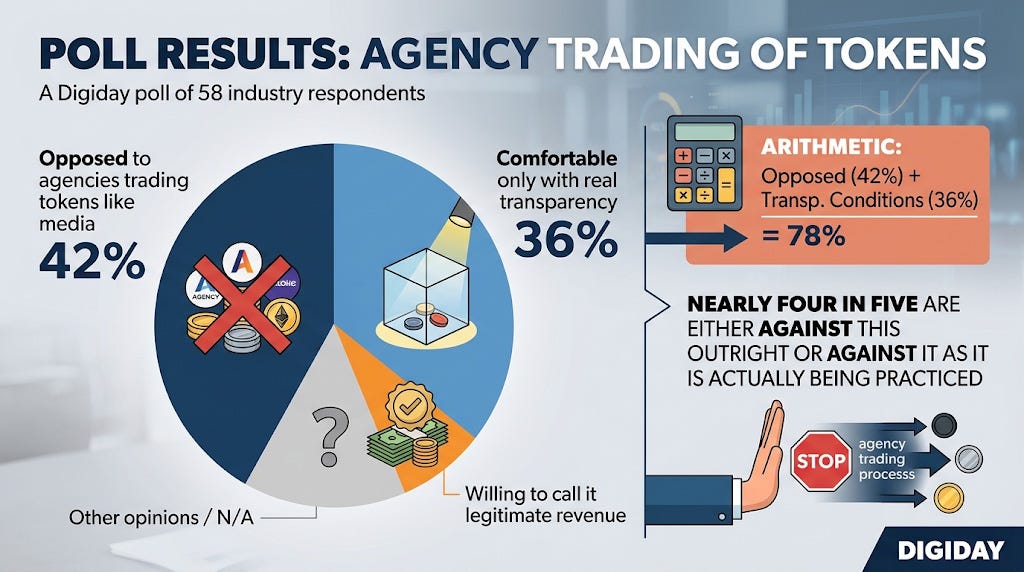
That is not an industry that has made peace with an idea. That is an industry watching a pickpocket work the room, correctly identifying the pickpocket, and then holding a show of hands about whether mentioning it would be impolite.
3. Rebranding The Bill As A Metric
Not everybody wants the cost hidden. Some want it hung on the wall, lit from below, with a small brass plaque.
Barry Lowenthal pitched a new metric in MediaPost this spring called “Performance per Token,” outcomes divided by media cost plus compute cost, positioned as the natural heir to CPM. Give the man his due, because the underlying observation is good and arguably first-principles. Historically 60 to 70% of agency operating expense was labor, and labor never once showed up inside a CPM, because nobody was metering the humans. AI labor is metered by construction, down to the fraction of a cent, whether anyone in this business wanted that or not. So for the first time the thinking half of a campaign carries a directly attributable, fully auditable unit cost.
All true. It is also precisely the sort of number an industry adopts with tremendous enthusiasm the instant it becomes flattering. Notice which cost is getting the laser measurement and which one is not. There is no proposal anywhere to standardize the markup applied on top of those tokens before the invoice reaches you. None. Not a working group, not a white paper, not a panel, not a single slide at a single conference.
Measuring the compute to four decimal places while leaving the margin on top of it in total darkness is not transparency. It is handing the client a beautifully calibrated ruler and pointing it at the one part of the bill that was never in dispute.
4. The Product Being Sold Does Not Reliably Exist
All of this scaffolding, the pricing chaos and the buried costs and the shiny new metric, is being erected around ad inventory that is at this moment empirically unstable to the point of visible flickering.
ChatGPT ads launched in the US on February 9, 2026 and reached five more countries by July. The climb was less a rollout than a cardiogram. Cloro’s independent tracking clocked US penetration at 49.1% of replies on May 26. Three weeks later the entire ad surface had fallen to 0.05% of measured responses. Near total disappearance.
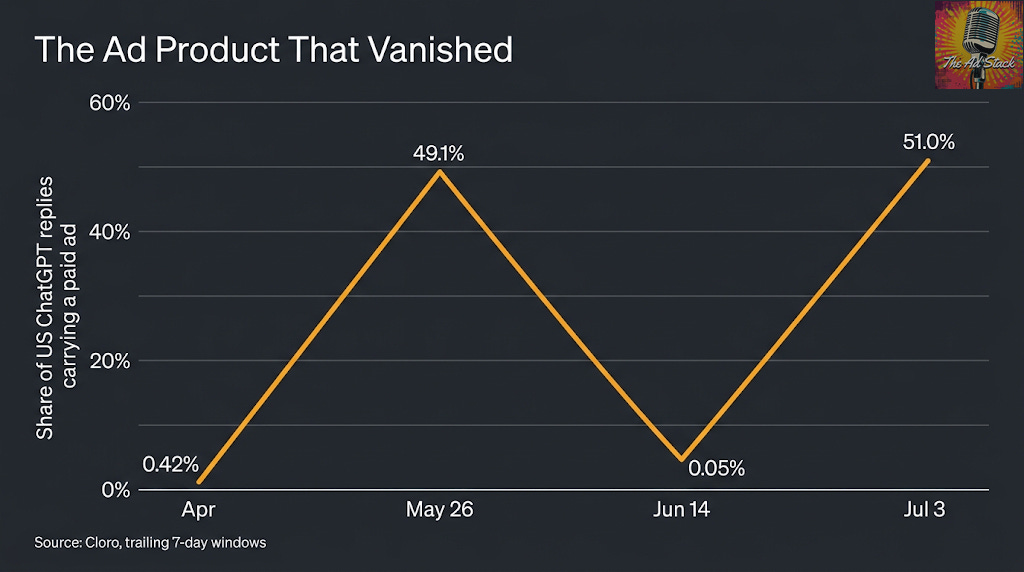
No announcement, no explanation, and as far as I can establish no particular curiosity from anyone about where half the inventory went. It began climbing again on June 26 and settled at 51.0% of US replies for the seven days ending July 3, with Canada at 53.6% and Australia at 49.8%. The product vanished completely and came back slightly larger than before, like a houseguest who leaves without saying goodbye and returns three weeks later with luggage.
Those are still the most current public figures anyone has, and the geography is stranger than the timeline. In the same stretch, search intelligence firm Adthena scraped 169,560 UK responses and logged zero ads. Not few. Zero, out of the 29,237 ad items it catalogued worldwide that month. Same product, same language, same advertisers, one Atlantic crossing, and the entire ad surface is simply not there.
Sit with the arrangement for a second. Agencies are committing client money to inventory whose existence has to be established by outside firms scraping a chat window, because the platform selling the inventory publishes nothing and has never explained the trough. In any other medium this would be a scandal with a hearing attached. Here it is a Tuesday (or Thursday/Friday in this case).
Perplexity ran this identical experiment first and had the rare good sense to stop. It tested sponsored answers from late 2024, then wound the format down through 2025 and into 2026. A company executive reportedly summarized the retreat in one sentence that ought to be cross-stitched, framed, and nailed above the espresso machine of every agency in the country:
“A user would simply start to doubt everything.”
Perplexity now takes $20 to $200 a month in subscriptions instead, an old and boring business model whose singular advantage is that it works.
OpenAI is betting that walling the ads off from the answer, free tier only, clearly labeled, paid tiers untouched, dodges the same trust collapse. Maybe. Sincerely, maybe. But the only two companies actually running this experiment in production have reached opposite conclusions about whether it can be survived, and the one still running it recently had a month-long stretch where its own inventory evaporated and has never felt moved to write down why.
Google, never one to arrive late to something it can charge for, used its Marketing Live keynote to announce ads embedded directly inside AI Mode’s conversational answers, a universal cross-Google checkout cart for agentic shopping, and a server-side tracking pilot built explicitly to route around ad blockers. Read that last one twice. Google’s own partners described the moment as one in which “execution friction is disappearing.”
Held up against everything above, that is a precise sentence. Just not the one they meant. Friction is disappearing for the platforms and for the agencies. It has not disappeared for the client trying to establish what a token cost, and it has certainly not disappeared for the advertiser who bought space inside a chat product that quietly stopped serving ads for about a month and never filed so much as a note.
5. The Bill Comes Due Either Way

A word is now a line item. A campaign’s thinking carries a metered price for the first time in the history of this industry, and almost nobody selling the metering wants it itemized.
The cost gets passed through, or absorbed, or buried inside a bigger media commitment, or promoted to a headline metric. Pick whichever framing keeps you from asking the only question that actually matters. What did the token cost, and who marked it up before it reached me?
Nobody in this business knows how to price the new currency. They have decided, with tremendous confidence and considerable margin, to spend it anyway, and to bill you for the exchange rate risk.
You are allowed to ask for the meter reading. You are allowed to ask twice. And then wait, because the silence is the answer.
See you next week.
pb
Forward this to whoever signs your agency contract. Then print the table and ask which row they are.
A Note On The Numbers
Ad penetration figures come from Cloro, which renders and parses the ChatGPT interface directly, since OpenAI publishes no official figures. Cloro sells monitoring services, so treat it as an interested party, and note that it is corroborated: Writesonic’s independent measurement of the same May window put US penetration near 48%, and Adthena’s UK scrape is a separate firm working a separate corpus. Cloro’s own methodology warning deserves repeating, because it cuts against the headline rather than for it: counts that bundle shopping cards in with paid placements run five to ten times higher than the true ad rate, and Cloro calls that the most common error in third-party reporting. Figures here are paid placements only. Country rates are trailing seven-day windows ending July 3, 2026, the most recent public measurement available.
Sources
Digiday, Agencies are struggling to account for AI token costs in budgets
Digiday, The case for and against agencies betting on tokens the way they bet on media
Digiday, How AI costs are quietly reshaping principal media deals
Monks, Steering the Machine: Our Take on the Agentic Shift at Google Marketing Live 2026
Not gonna lie, this is near Pulitzer material. I'm not shocked, mind (by the content), but you did a tremendous job laying it all out. The crazy thing, as you point out, is the behavior isn't new, only the product is. "What's the latest thing that isn't fleshed out and we can hide piles of money on?" (social, NFT, Metaverse, principal-based media buying...). The difference now is it's a total gamble on all sides and the only sure winner is NVIDIA.